The lions do not have the last word: Cardinal Koovakad preaches the 377th Lion Sermon
Updated: 12 hours ago
Nearly four hundred years ago, as night fell over the Syrian desert, a London merchant found himself alone and face to face with a lion. Sir John Gayer had become separated from his companions on a trading mission. He was a long way from Leadenhall Street, and further still from help. Fearing for his life, he cried out to God; and the lion left him unharmed.
Sir John came home grateful, and his gratitude took a very physical form. He gave money to his parish of St Katharine Cree for the relief of the poor, and for a sermon to be preached every year on the theme of facing our challenges with the help of God. He is buried here, and the sermon has never stopped.

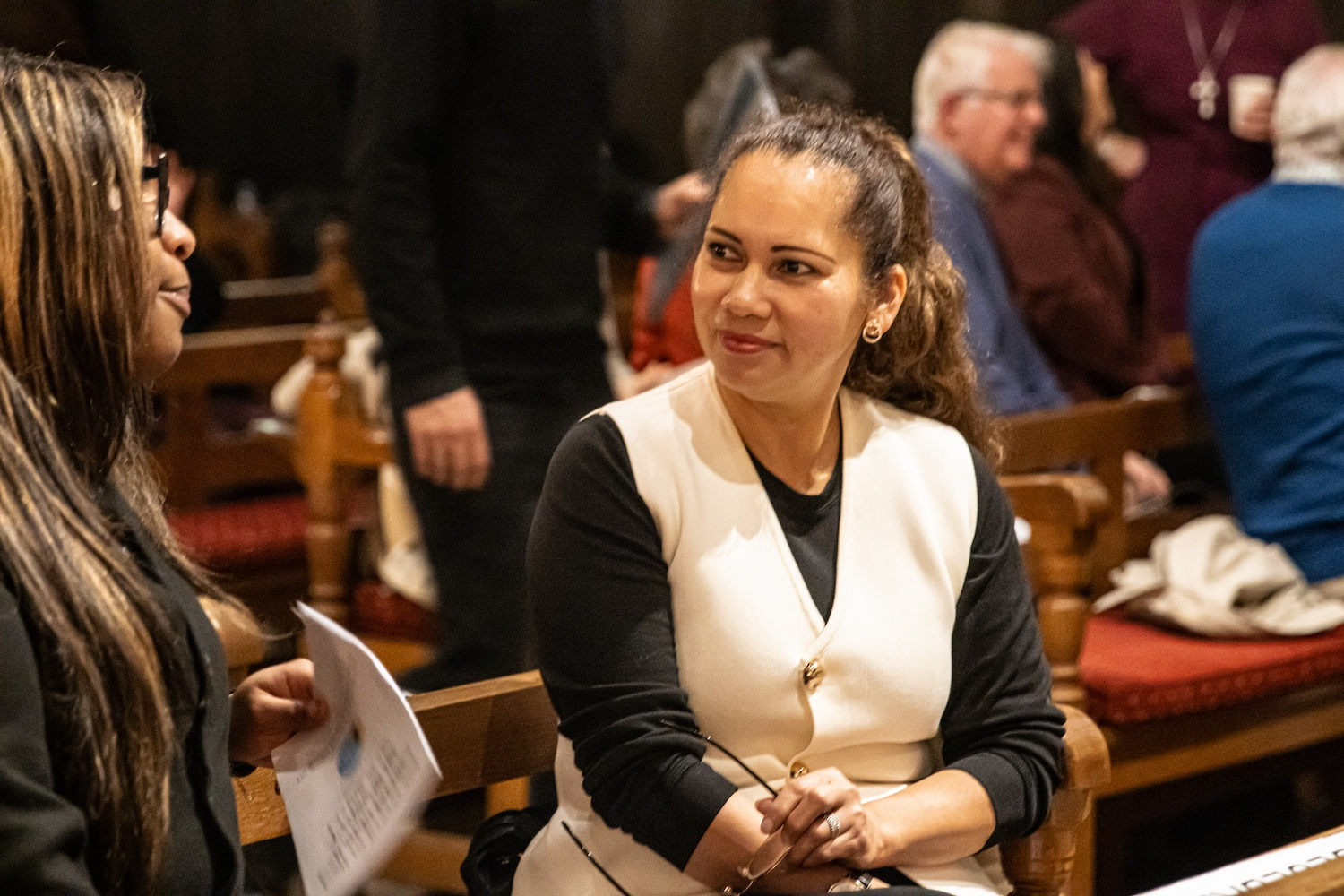
Last night, the 377th Lion Sermon was preached by Cardinal George Jacob Koovakad, Prefect of the Vatican's Dicastery for Interreligious Dialogue. Born in India and ordained in the Syro-Malabar Church, the Cardinal served as a diplomat of the Holy See in Algeria, Korea, Iran, Costa Rica and Venezuela before leading the Roman Catholic Church's global dialogue with people of other faiths. He preached within Choral Evensong, sung by the Lloyd's Choir, to a congregation that included City workers, friends from across the Christian churches, and guests from other faith traditions.
For us, his presence carried a particular meaning. In 2024 our Latin American congregation received a personal letter from the late Pope Francis, offering his prayers and encouragement for our ministry in the City. To welcome the Cardinal into our pulpit two years later felt like the continuation of a friendship: a sign of a shared and longstanding commitment to dialogue and understanding, both between churches and between faiths.
Three lions
Cardinal Koovakad began with Sir John's story, and then turned it towards us. The lions of our own age, he said, are many. He named three: an ecological and economic crisis that falls hardest on the poor; a geopolitical crisis in which wars are multiplying and the structures of international cooperation are under strain; and a religious crisis marked by rising nationalism, polarisation and discrimination. "These crises are not separate," he said; "they are woven together." Those who suffer most are often those who already have least, among them religious minorities across the world.
The tower and the wall
Drawing on Pope Leo XIV's new encyclical, Magnifica Humanitas, the Cardinal set two images side by side. The first was the Tower of Babel: a project of pride and self-sufficiency, which sacrifices difference to uniformity and ends not in unity but in dispersion. Preaching in the shadow of the City's towers of glass and steel, he did not need to labour the point. He warned, with the Pope, against a vision of life that equates fullness with "having more, reducing weakness, eliminating uncertainty and exerting total control".
The second image was Nehemiah, rebuilding the walls of Jerusalem. Nehemiah did not impose a solution from above. He prayed; he listened; and he gave each family its own section of the wall to rebuild. The city rose again not through one man's initiative but through the shared work of all. It was, in the Pope's words, an undertaking that "rebuilds relationships before rebuilding with stones". Our calling, the Cardinal suggested, is not to build higher, but to build together.
Seeds of hope
This was not a sermon of gloom. The Cardinal spoke of the quiet growth of interreligious collaboration over the past twenty years, from the Document on Human Fraternity signed in Abu Dhabi to local partnerships between communities of different faiths working on poverty and the care of creation. He called these "seeds of hope". They are not always noisy, and they are hard to measure; but they are real. Where many have turned away from public life, he observed, people of faith, and especially young people and women, are walking into it together.
He also spoke generously of St Katharine Cree itself, and of the ministry that has grown here in recent years among the City's hidden workers: cleaners, security guards and others whose labour keeps the Square Mile running. Faith, he reminded us, does not belong only behind closed doors. It belongs "in the places where human beings labour, trade, hope and struggle together." That is what a Guild Church is for.
He ended with a simple invitation: to plant one seed of dialogue this week, with a neighbour, a colleague, or a stranger of another faith. "Seeds are small," he said. "But every forest began with one."
A lasting friendship
We are deeply grateful to Cardinal Koovakad for his friendship to St Katharine Cree, and for the bonds between faith communities in London and beyond that his visit has helped to strengthen.
Sir John Gayer met his lion alone, in the dark. Last night, as the light faded over Leadenhall Street, we sang the old Evensong prayer: Lighten our darkness, we beseech thee, O Lord. We still pray it. But the Cardinal's sermon reminded us that we no longer face the lions alone. We face them side by side, across our churches and our faiths; each of us, like Nehemiah's families, with our own section of the wall to build.
The full text of the Cardinal's sermon is available here: